

Can We Justify College ?


AI is starting to impact hiring for young men and women with recent college degrees and I fear that this will lead to a sense of hopelessness and further deepen a crisis of purpose. Job postings for entry-level positions are down by nearly 15%. Higher Education is being pressured to prepare students for a future that industry is increasingly signaling may not have a place for them. Many young people will start asking what’s the point of going to college, taking out debt, spending years of their life learning skills if they cannot secure a job afterwards.
As reported in Axios this week, corporations are choosing automation over asking their employees to use AI to augment their skills.
“Two developments unfolding this week show urgent reasons for acute concern:
Amazon announced yesterday that it’s cutting 14,000 white-collar jobs. JPMorgan, Walmart, and others have revealed plans to slow hiring. All cited AI. PwC, the accounting and consulting giant, cut staff globally, partly because of AI. Nestlé cut jobs, blaming automation.
As importantly, a 2-year-old company with a 22-year-old CEO, founded by three college dropouts, was just valued at $10 billion, according to The Wall Street Journal. The San Francisco company, Mercor, pays doctors, lawyers and others to train AI so machines can perform like human professionals. This is part of a mad rush to fine-tune AI with true human expertise so it can do for free what junior employees do now — and, later, what senior ones get paid good salaries to do.”
What Is It Like Trying to Get a Job Right Now
Not only are we seeing positions eliminated or consolidated because of AI, but the entire digital hiring process is broken because of it. Recruiters are now awash with AI-generated resumes from applicants that are trying to game AI applications systems common throughout hiring. Recent graduates are reporting that it is nearly impossible to get a human being to read their job application materials.

Worse still, certain positions like coding and data science are feeling the outsized effects of people turning to AI to “vibe” code instead of programming manually. Some Coding academies are starting to close as industry signals a lack of interest in human skills for these roles.
The Efficiency Trap
The message that much of industry has sent to higher education is to upskill and start teaching students AI skills for a future that’s constantly arriving, but the message relies on the implicit assumption that AI will be a force that allows human beings to use AI to augment their skills, not automate them away into irrelevance. It may not matter how fluent our students are in using AI if corporations such as Amazon decide there isn’t a place for them. According to leaked documents to the New York Times, Amazon plans to invest so heavily in automation that nearly 75% of their operations will be entirely automated by 2033. That includes white collar jobs, not just those on the factory floor. This means they’ve not only laid off folks, but they don’t plan to hire up to 600,000 people over this period of time.
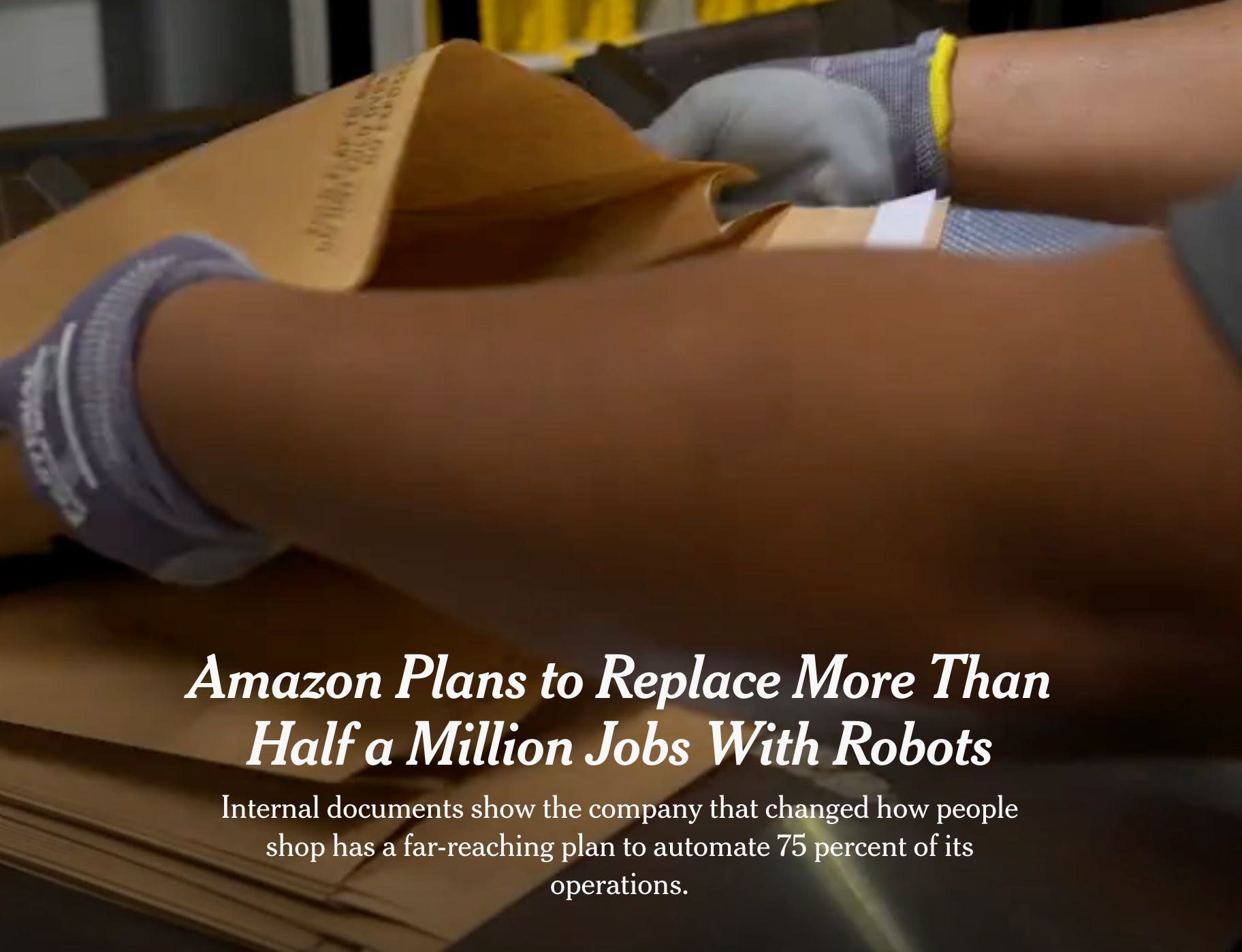
That last part truly scares me. Companies don’t foresee the need to hire new people for roles that machines have largely taken over. If this becomes widespread, and it appears that’s the way many companies are starting to view AI’s role in industry, then we’re potentially seeing the door close for an entire generation of students who will be saddled with debt from college with no clear path to a career.
All of this is being done in the name of gargantuan corporate profits. Google is reporting a massive $100 billion dollar quarterly profit, and Nvidia has gone from a company valued at a trillion dollars to five trillion dollars in less than two years. All of this is due to AI. So much for a bubble. The balloon just keeps on inflating.
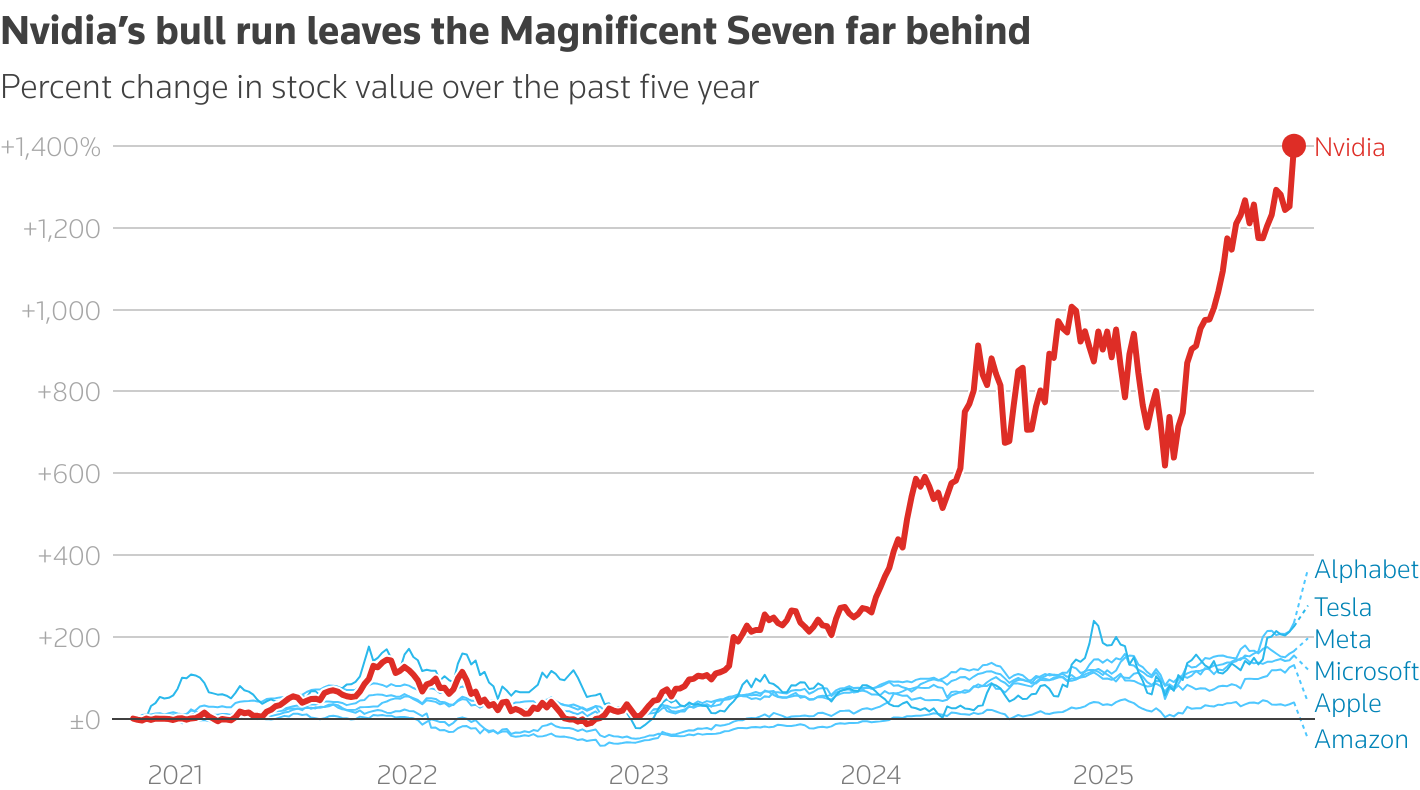
Companies are investing heavily in AI because it allows them to eliminate positions that were traditionally middle management roles.
AI is a Public Policy Problem
November will mark three full years since ChatGPT was launched and I cannot believe how quickly things have changed in education and throughout society. We need to prepare for possible lasting changes and that can only happen as a matter of federal policy. That’s not an easy task and it is one that AI developers are steering. Anthropic’s recent Preparing for AI’s Economic Impact: Exploring Policy Responses reads like a science fiction dystopia, but some of these policy proposals may likely be in our near future if things don’t change.
General Policy Suggestions:
1. Invest in upskilling through workforce training grants
2. Reform tax incentives for worker retention and retraining
3. Close corporate tax loopholes
4. Accelerate permits and approvals for AI infrastructure
Policy ideas for moderate scenarios
5. Establish trade adjustment assistance for AI displacement
6. Implement taxes on compute or token generation
Policy ideas for fast-moving scenarios
7. Create national sovereign wealth funds with stakes in AI
8. Adopt or modernize value-added taxes
9. Implement new revenue structures to account for AI’s growing share of the economy
You can read about each more through the Anthropic report. Why are we allowing one of the largest AI companies on the planet to voice policy proposals for problems they’ve contributed in creating? I’m not saying there’s not room for their voice in all of this, but if AI developers become the leading voices in public policy conversations, then we are truly at the mercy of corporate interests verse public good.
We need private citizens and independent organizations to help steer these conversations. I don’t foresee a polarized Congress taking up any of these policy positions. We’re in the midst of a government shutdown and even if we weren’t, the idea of bipartisan support for radical policy changes related to a technology few in their 70s and 80s can barely comprehend isn’t realistic.
AI is not Inevitable, but Industry Thinks Automation is Acceptable
I’ve long resisted calling AI inevitable, but corporate interests are creating a landscape where using AI to automate labor is now acceptable. Losing your job because of machine intelligence transcends narratives decrying AI as just hype. Real people are getting hurt. Dreams are being dashed so profit margins remain astronomically high.
For generations, a college degree represented a path into a secure middle-class life, one that often included a 30-year mortgage, a community, a sense of belonging and purpose that gave people a shared dignity that went unspoken. While it was far from perfect, a college education was at least one part of the complex equation that offered many people a way to finding the American dream. It feels like that’s ending, or at the very least, being diminished greatly.
In higher education, we’ve been so focused on securing learning and assessments from AI abuse that we’ve missed the great point of why we’re drawn to do this in the first place. It’s because we believe in the value of the degree. We think the credential holds meaning that you can assign a dollar amount to it, which makes millions of young people take out loans to receive it. Yet credentialism doesn’t matter if the economy stops valuing the organic intelligence behind it in favor of cheap machine alternatives.
The thing is, not everyone is going to lose their jobs. Mid-career folks have both the experience and capacity to adjust, to some degree, and roll with these changes. Many industries will be reluctant to fully rid themselves of those employees who possess the deep corporate knowledge that comes from years of navigating endless upheaval, but the ladder leading to that stage is no longer secure. Fewer internships, less mentoring, and the elimination of junior roles are becoming the norm.
The decline of the entry-level job market isn’t a policy problem we can fix with the right grants or tax incentives. It’s a structural choice corporations are making, and they’re making it because it works for their immediate interests. That’s what sucks about all of this. Shareholders will reward automation over hiring because quarterly earnings matter more than a generation’s future. And for them, if it isn’t a record profit, then it is no profit at all.
Universities are caught in the center of this. We’re supposed to make students job-ready for positions that may not exist. We’re supposed to preserve the value of the degree while the economy systematically devalues the people holding them. We’re supposed to be honest with students about an uncertain future while also convincing them to take on six-figure debt.
There’s no resolving that. Not with resisting AI by teaching students about critical AI literacy to help them process these impacts on society, and not by adopting it through AI fluency initiatives that promise students the skills they need to be AI ready. We need policy proposals that arise from communities that see this playing out in real time. We need to hear from teachers, economists, workforce offices, and humanists that can articulate the value of human skills and human intelligence.
Writing as a high school teacher with two 20-something kids, I see you eye-to-eye, but this situation is also a potent case for pulling college education away from vo-tech education, which it has become for so many, back to liberal arts skills of discernment and vision.
I share your concern here. For so long university systems have benefitted from the position of job training, and if the bottom falls out of the job market, then so goes that argument. There will still be room for colleges and universities as social credentialism, and there is a hope that this shift might create the room for universities to reposition as spaces for personal and intellectual growth as a good of itself.
I still think the chickens will come home to roost. I don't think OpenAI will be able to spend at a gargantuan loss forever, and there will be an uptick in hiring again. But the damage from this devaluing of human creation is irreparable.