



It’s been nearly four years since the public release of ChatGPT, and discussions about AI in higher education remain focused on academic integrity concerns. Instead of asking how we can catch students using AI, it is time to shift the focus from AI as a cheating tool to deeper questions about the role human educators play in shaping knowledge and the values we hold about learning.
A few months ago, the President of the University of Chicago riled many when he announced that his campus was activating Anthropic’s Claude. Included in that announcement was the following sentence that has lingered with me ever since: “Instructors at all levels are navigating a fast-evolving landscape, and the University has a duty of care to ensure that the education offered to you is responsive to these technological developments by teaching you how to think with machines, how to think without them, and how to think about them.” Many disagree about AI’s role in learning, but one thing I firmly believe is that our approaches to AI should be rooted in asking what our duty of care is to our students right now and what our campuses owe faculty. A duty of care is an obligation in strict legal terms, but for educators, it is an ethos that forms the unspoken compact that governs our mission.
How to Think Without Machines
Answering that question for the classroom is complicated. It’s supposed to be. When I teach a first-year writing course, I believe that duty of care is in helping students preserve as much of the thinking and critical decision-making that makes rough drafts possible. I’m not interested in asking students to use AI to brainstorm or help them develop a draft. Writing is supposed to be messy. I want my students to feel empowered to take risks and accept ownership of their words. AI might be appropriate as a feedback tool, with my oversight, but that’s about it. To preserve that first draft, I might pursue changes to my course policies, like James Seitz’s policy of asking students to write in class on laptops, preserving student accessibility while requiring them to deactivate their Wi-Fi and put their word processors in focus mode.
However, if I wanted to pursue a mixed strategy and have students both think without and with machines, I would look to mirror Mark Marino’s Analog Sandwich approach of separating writing assignments into analog components or writing sessions in controlled environments before introducing them to a variety of AI tools for research and drafting. Marino does this for his in-person class using physical notebooks at certain times before shifting to devices. For an online section that required enhanced security, I could use programs like Draftback to capture writing process data or use a lockdown browser for certain assignment types.
How to Think About Machines
I also teach within a Digital Media Studies program, and the entry-level course asks students to analyze and reflect on how new technologies alter our interests. Applying the duty of care AI framework for this course means asking students to think about how machine intelligence is impacting society and culture by having them examine various AI outputs and read the words of other scholars and research news sources. Since critical thinking and analytical reasoning are my primary goals, I often ask students to avoid using AI or, at minimum, disclose how they are using it for the sake of transparency.
For DMS, I find myself creating applications that ask students to critically engage with how AI works, like my experiments around Reading Faulkner in the Age of Thinking Machines, creating activities like a Sentence Sound lab to show how AI can transform and complicate traditional experiences, or presenting outputs others have generated as examples for students to interact with more often than asking them to use a chatbot. I do so because I want to emphasize skills students need for an entry-level course rather than focus on asking students to become fluent in using one AI tool or another.
Thinking With Machines
I also teach an advanced course for juniors and seniors within my department’s major that combines all three approaches, including asking students to use AI beyond simple text generation. I think that matters. I’ve argued before that the current ways students and the general public use generative AI are either as an answer machine or to generate rote outputs, like PowerPoint on steroids. I believe there’s a duty of care to show students what advanced AI looks like within their discipline and give them space to explore applications with faculty who are likewise curious about what the technology is capable of doing.
When I teach Writing 381 about AI and society, I plan to ask my students to use AI to explore ways they can use AI that are new and novel. There are hundreds of databases that they can create apps for using free API calls. I used Wikipedia to create my Anatomy Workshop that asked them to juxtapose AI-generated 3D meshes of human organs with real ones. My partner teaches an environmental writing class, and I vibe coded an activity where students can place a circle on the map of the US and see what plants and animals other flesh-and-blood human beings have taken the time to catalogue for more than a century. The app turns the activity into a short assignment, asking students to pause and see the world around them and ultimately draft a short ecological narrative that is meaningful to them.
Applying a duty of care framework to how you and your students approach AI can certainly be meaningful and deeply impact the way your students navigate AI. Indeed, entire academic programs are taking such pathways, like the University of Chicago’s Law School. First-year law students will not be able to access technology in courses—they’ll need to show what they know without AI. However, as they progress through the program, they’ll be granted more and more access to various AI tools and begin to see how AI impacts the legal profession.
The Duty of Care Institutions Owe Faculty
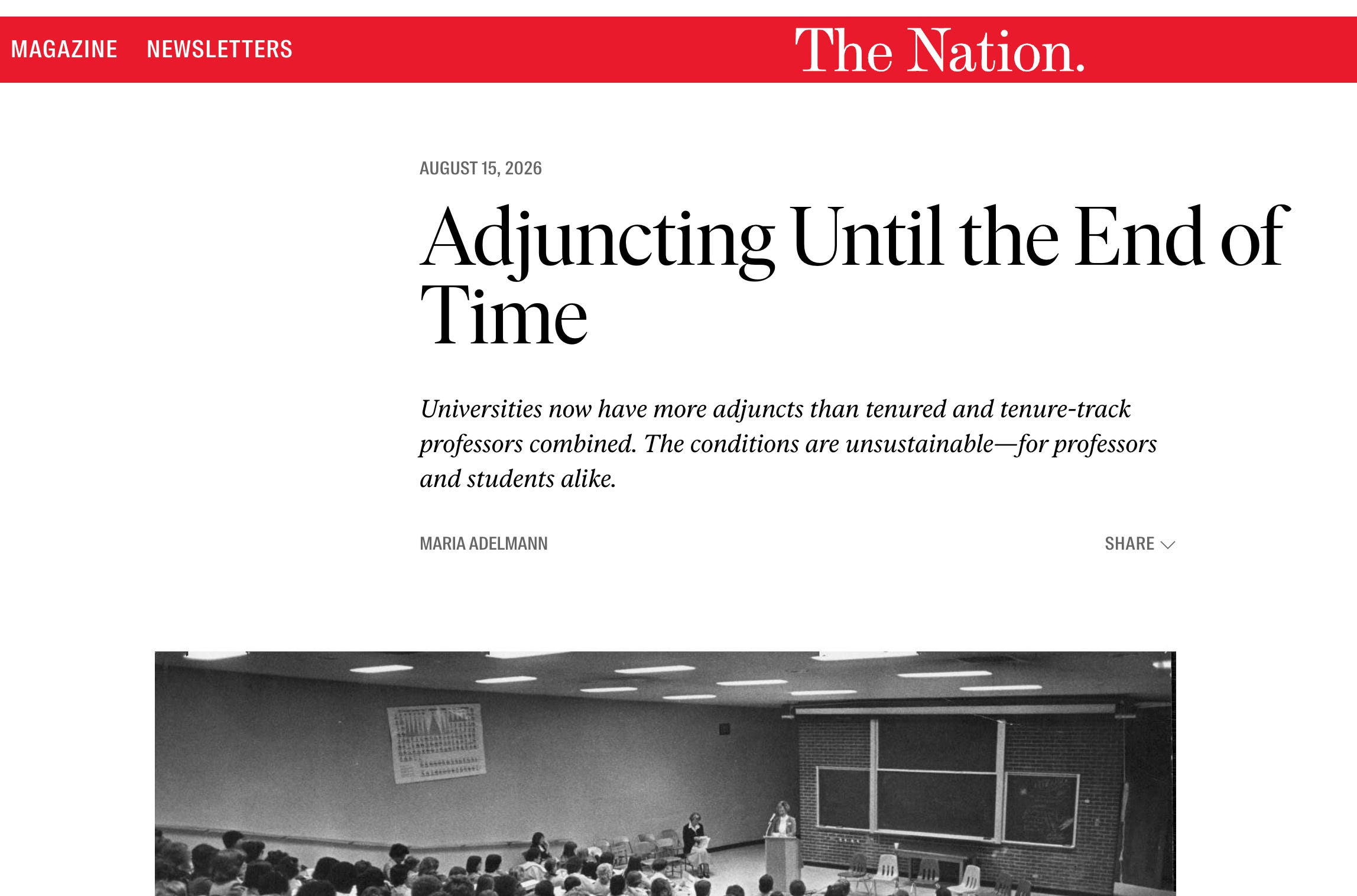
Putting the onus on faculty to accept the responsibility of deciding what duty of care to apply to their students does not excuse institutions from the conversation. Higher education has created a labor model that treats human beings as disposable cogs. Maria Adelmann’s Adjuncting Until the End of Time lays bare certain uncomfortable truths that seem lost on the general public: “Universities now have more adjuncts than tenured and tenure-track professors combined.” Most faculty on college campuses are contingent and have been for my entire teaching career. They often work multiple jobs, struggle to attain healthcare, or find reasonable stability necessary to do their jobs. Before I was hired full-time in 2013, I taught as an adjunct instructor at two different campuses. Teaching a 5/4 course load allowed me to earn $28,000 a year. Mind you, a full load of classes in my field is considered a 4/4. Even teaching an overload as an adjunct meant it was structurally impossible to earn a full-time salary.
Asking faculty to decide how best to navigate AI when their own working conditions are not being properly supported creates an absurd environment where the least supported are often tasked with making some of the most consequential decisions for students—all while parents, policymakers, and the students themselves are completely oblivious to this reality.
Faculty should have financial security, training, support, and time to learn about different approaches to AI; otherwise, there’s little point. In all the talk about rigor and grade inflation, what’s lost is the tremendous burden placed on many of the most vulnerable members of our campus. They work beyond their contracts to support students through extended office hours, often serving as the primary point of contact for many students during their first year on campus.
Teaching Discernment, Not Compliance
We ultimately want students to take ownership of their choices about navigating AI and not expect to be handed a playbook when they graduate. We want them to internalize these questions. Instead of teaching students to use AI responsibly, I want them to develop a framework where they can create and sustain an internal model of how they approach AI in their world based on their values. For me, that’s all about discernment. I don’t define that concept around discerning if an AI output has hallucinated facts or checking to see if it contains errors; such a definition implies that the choice to use AI has already been made. Discernment is as much a question about intentionality and the role agency plays in choices around generative AI.
That’s why exercises, like Pause Before You Prompt, developed by Maggie Boyd and colleagues at Boston University, can be such powerful teaching tools. It’s remarkable how much of an impact asking us to stop and consider the choices we make can have in informing our approaches to technology, like AI. Inviting students to reflect on these choices activates metacognition and allows them to form deeper connections between their decisions and their learning.
If we only focus on the AI is cheating discourse and pour our efforts into pursuing academic integrity cases, we risk alienating our students from our core mission of teaching. That doesn’t mean we give up on securing assessments. A major part of any duty of care approach will certainly involve redesigning assessments so that they are more secure, but doing so cannot simply be a return to blue books or proctored exams. Students need authentic learning opportunities that invite them to use new technologies, like AI at certain times, and restrict it in others. The University of Sydney’s Two Lane Approach to Academic Assessment is an imperfect response, but it remains the most robust model of an institution reforming its assessment practices to account for AI’s influence.
The Duty of Care We Owe One Another
How you approach the question of AI and what it means to your values is the most important question of all. At many institutions, faculty have been charged with coming up with their own AI policies for their classes, but few campuses have offered guidance about how faculty, staff, or administration should approach the question of AI in their daily interactions and task. We’ve seen people send their AI agents to Zoom meetings to record for them when they aren’t present, and stories about faculty using AI to answer emails, write letters of recommendation, and even grade student work.
Policy isn’t coming to dictate your approach to AI. If there were such a policy, it would be the size of a phonebook, telling us what one may do, may not do, etc., for research, teaching, promotion, communication, and countless other activities we perform daily. Just as students will need to internalize a model where they can approach the question of using AI, we as faculty must likewise put such questions to ourselves.
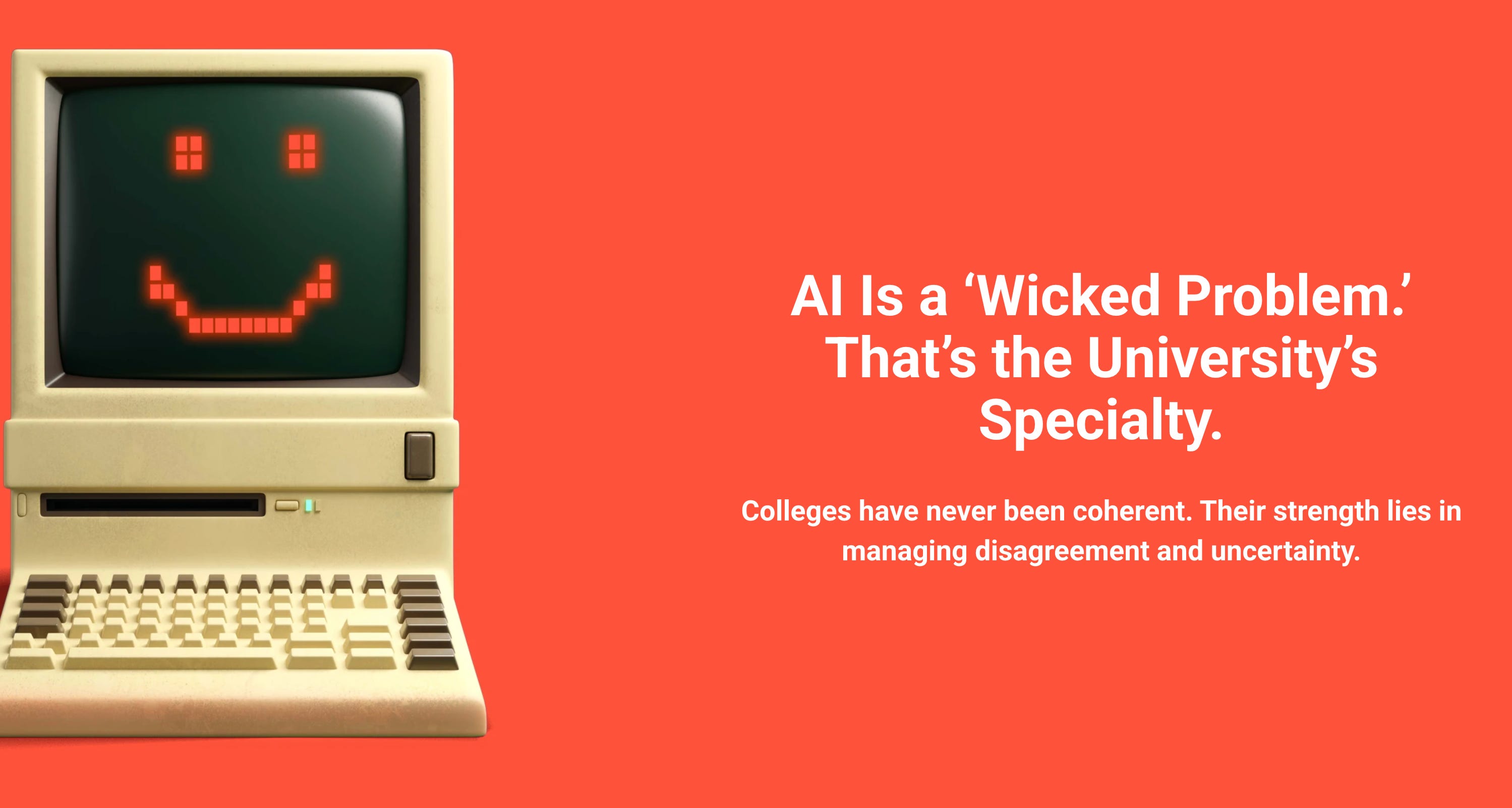
Asking what duty of care we have to ourselves, our disciplines, our students, and our community is where we reaffirm our mission and develop our values. AI represents an opportunity for us all to renew such commitments. The public has soured on the notion of higher education because of skyrocketing costs and politics, but this is a chance for campuses to communicate what makes the US system of higher education unique among the world. As Clay Shirky argues in AI Is a ‘Wicked Problem.’ That’s the University’s Specialty; our role is in “the management and maintenance of incoherence.” Universities are places where people learn to embrace “multiple and inconsistent points of view, and working through the implications in our maddeningly discursive ways.” Our duty isn’t to settle the question of AI for students. It is to create and affirm the conditions in which we can all learn to settle it, thoughtfully and repeatedly, as a community.
Order The Norton Guide to AI-Aware Teaching
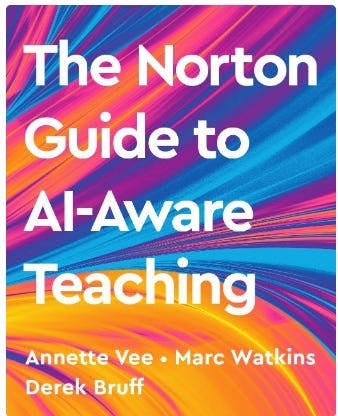
The Norton Guide to AI-Aware Teaching is now available to order as an ebook! Print copies are expected to start shipping on September 24th. Here’s how you can get a copy:
Our publisher Norton is pleased to offer the guide as a free ebook for all instructors currently using a Norton textbook. If that’s you, you’ll receive access from the Norton team when the ebook is available July 1st and can contact your local Norton representative with any questions.
If you would like to order the ebook, you can now do so through Amazon and Barnes & Noble and other retailers.
If you would like to pre-order the paperback version of the book, you can now do so through Norton, Amazon, Barnes & Noble, and likely other retailers. If you go through Norton, be sure to use the code AIFREESHIP at check out to get free shipping!
If you would like to order multiple copies for a campus reading group or some other faculty development effort, Norton has an option for you: On orders of 10 or more print copies, we offer 50% off the list price and free domestic shipping. (Such orders must be on a nonreturnable basis.) To take advantage of this offer, contact Peter Wentz at pwentz@wwnorton.com with subject line “Norton Guide to AI-Aware Teaching.”
I really enjoyed reading how you elaborated on “duty of care” here. Thank you. I think Chicago is doing some of the most interesting work right now in this space, both with this framing explaining the need for an institution-wide AI tool, and with what the law program and the core curriculum is doing in cloistering entry level courses to protect foundational learning. Of course, Chicago is a very unique institution, and the institutional demands that you advocate for here, with which I totally agree, are unlikely to become reality everywhere.
Your post also helped me advance my own thinking in what “duty of care” implies for AI literacy at the university level. I think it’s more than deciding when to use the tool, although that is a big part of it. Our students will walk in a world of ambient gen AI systems, and I am increasingly convinced that a key part of what any person will need in that world is their own individual “core global instructions:” their own collaboration and relational model for working with AI, and their own sense of how to constrain the tool to their own human bandwidth and pace, their own cognitive budget. Some of us now working with these tools, especially tools like Cowork that accrue power and capability with persistent context, are experimenting with this. It is one area I want to think more about: how to help students develop their own version of such a “constitution” to constrain whatever AI tools they encounter.
Even as we demand that institutions follow their own “duty of care” towards faculty, we all know how much of an uphill struggle that will be, especially with all the headwinds, and not just economic ones, blowing us down. And the more I think about how to respond to the challenge of AI in higher education, the more I am convinced that the answers will revolve around disciplinary imperatives and ways of thinking. This convinces me that disciplinary societies are another place where faculty can use a “duty of care” framing to help us balance both our mission to protect student learning and the need to prepare them for the world as it is.
(I’m trying to document my own process of creating such a “constitution” — here is the overview post, if useful, with links out to deeper dives: https://mivonnewf.substack.com/p/seatbelts-for-pod-racers-cognitive)
I like the "Duty of Care" as a model for thinking and talking about AI with students - I think it will resonate with many if it's coupled with sincere efforts to explain where and where AI tools inhibit and, potentially, offer possibilities for learning. Otherwise students will continue to be left to their own devices where they will obviously make choices that are not always in their best interests.